SEMA_________________________________
SOUTHEASTERN MEAT ASSOCIATION
P.O. Box 620777; Oviedo, FL 32762 Phone: 407-365-5661
NOVEMBER 2011 |
VOLUME 26, No. 11 |
What’s New
Latest Version of Employer Handbook – Instructions for Completing Form I-9 (Employment Eligibility Verification Form) (M-274)
http://www.uscis.gov/files/form/m-274.pdf (Note: Version 06/01/2011)
For general information about completing or updating Form I-9, consult the Handbook for Employers: Instructions for Completing Form I-9 (M-274).
Provided by, Hector Chichoni P.A., Duane Morris LLP, Miami, FL - 305 960 2277
Meat Processing & Food Safety Class
SUNY Cobleskill in Cobleskill, NY is offering a 1 month long training program in Meat Processing and Foods Safety Program. The class is offered twice a year in January and June. This is a working farm and one of the only colleges to have a USDA Meat Processing facility on campus. Our instructors only take 10 students and students will obtain a basic understanding of the steps involved in livestock processing from slaughtering to the actual retail cut that you see at the store. This is an intensive hands-on training designed to provide the knowledge and skills required to enter employment in the meat processing industry. If interested in the program, please call Linda Serdy at 518-255-5528. The cost for this four week training is $2,995. Housing can be obtained either on campus or off.
Check out www.farmforward.com and www.AbattoirRising.com and see SUNY Cobleskill’s Eric Shelley, instructor for Meat Pro. Abattoir Rising is a wonderful piece on the SUNY Cobleskill meat processing facility and instructors.
FDA Extends Comment on FSMA Small Business Fees
FDA is extending the comment period to November 30, 2011 for the Federal Register Notice, “Burden of Food and Drug Administration Food Safety Modernization Act Fee Amounts on Small Business; Request for Comments,” that originally appeared in the Federal Register on August 1, 2011. The Agency is taking this action in response to requests for an extension to allow interested parties additional time to submit comments.
This Notice can be viewed at http://www.gpo.gov/fdsys/pkg/FR-2011-10-18/html/2011-26815.htm.
FSIS Directives & Notices
FSIS Directive 8010.3 Revision 3
FSIS issued Directive 8010.3 Revision 3, “Procedures for Evidence Collection, Safeguarding, and Disposal.” It provides the methodologies and procedures that FSIS personnel in the Office of Program Evaluation, Enforcement and Review (OPEER), Office of Field Operations (OFO), Office of International Affairs (OIA), FSIS Laboratories, and other program areas (collectively referred to in this directive as program employees) are to apply when collecting, safeguarding, and disposing of evidence in the performance of surveillance, investigations, and other activities under the Federal Meat Inspection Act, (FMIA), the Poultry Products Inspection Act (PPIA), the Egg Products Inspection Act (EPIA) and related laws and regulations. This Directive can be viewed at http://www.fsis.usda.gov/OPPDE/rdad/FSISDirectives/8010.3Rev3.pdf.
FSIS Directive 7120.1 (Oct 12, 2011; PDF Only)
Safe and Suitable Ingredients Used in the Production of Meat, Poultry and Egg Products - Revision 8
FSIS Directives Issued: (Sep 28, 2011; PDF Only)
Note: Do Not Implement These Directives until November 12, 2011
FSIS Directive 5000.4 Revision 1
Performing the Review Component of PBIS 01b02 Procedure and PHIS Pre-Op Sanitation SOP Review and Observation Task in Federally Inspected Processing, Slaughter and Import Establishments
FSIS Directive 5000.5 Revision 1
Verification of Less Than Daily (LTD) Sanitation Procedures In Processing Operations
More at http://www.fsis.usda.gov/Regulations_&_Policies/index.asp
FSIS-ASK
Ground Beef Product Subject to non-O157 STEC Testing
Q: It is quite common to use frozen beef raw material in ground beef. It was stated in the Federal Register Notice that when testing is expanded to ground beef, it will be announced in the Federal Register. Will the Agency test ground beef that contains beef trim that was produced prior to March 5, 2012?
A: For the reasons stated in the answer "Product Subject to non-O157 STEC Testing", when FSIS implements testing of ground beef for non-O157 Shiga toxin-producing E. coli (STEC) (in addition to O157), FSIS intends to test ground product produced from source materials derived from cattle slaughtered on or after March 5, 2012.
Things to Ponder . . . . . . I contend that for a nation to try to tax itself into prosperity is like
a man standing in a bucket and trying to lift himself up by the handle.
-- Winston Churchill
NAMP Annouces Webinar with Engeljohn on “Big 6” Non-O157 Stecs’s, E. Coli O157, AND HACCP Validation NOV. 15th At 2 P.M. EST
NAMP announced a new and major webinar on all aspects of FSIS E. coli policy, including the “big 6” non-O157 STECS, E. coli O157:H7, and the pending HACCP validation guidance document. The webinar will be held on Nov. 15 at 2 pm EST. Dr. Dan Engeljohn, Assistant Administrator for the FSIS Office of Policy and Program Development, is the presenter.
This is the first major FSIS event with the industry since FSIS announced it would designate the “big 6” non-O157 STEC’s as adulterants – and since it released the review of its revised HACCP validation guidance document by the National Advisory Committee on Meat and Poultry Inspection (NACMPI).
Participants may register at the member rate of $59, or the non-member rate of $89. A $10 late fee will be charged after Nov. 10.
The webinar is co-hosted by the 12 organizations that co-sponsored NAMP’s E. coli conference in Chicago:
American Association of Meat Processors (AAMP), the American Meat Institute Foundation (AMIF), the American Meat Science Association (AMSA), the Chicago Mid-West Meat Association (CMMA), the Canadian Meat Council (CMC), the Eastern Meat Packers Association (EMPA), the International HACCP Alliance (IHA), the National Meat Association (NMA), the Southeastern Meat Association (SEMA), the Southwest Meat Association (SMA), the U.S. Meat Export Federation (USMEF), and the Beef Industry Food Safety Council (BIFSCo).
To register, go to www.namp.com.
SEMA Member News
|
When Ted Wampler Sr. started Wampler's Wholesale Meats in 1953, he invested more than $1,000 in the business - money he had saved in his childhood by selling blackberries and fish bait. Wampler's Farm Sausage Company on Highway 70, Lenoir City, today occupies the same land on which it originated, but it looks somewhat different. Son Ted Wampler Jr. has converted a sunny hillside once covered with wild blackberries and brambles into a "cutting edge" program to help carry the business forward for a new generation. On Oct. 22, Wampler's also will host an "open house" event and provide tours to those in the community who want to see the $2.5 million solar setup. The future is looking so bright that Wampler's provided attendees with sunshades, imprinted with their new slogan, "Sausage, burgers and brats, made with the sun." |
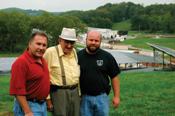
Energy generated by Wampler's also will be returned to the grid during peak energy usage times, helping to reduce the cost of energy for all in East Tennessee, said Ted Wampler Jr., president and chief operating officer.
The solar energy program was funded with help from a $250,000 TVA Generation Partners grant, a 10 percent grant with 90 percent local match, and a United States Department of Agriculture Rural Energy for America program loan. It is among the larger solar projects in the state to be undertaken by a private company.
"If you think about it, the electric company must build its infrastructure to meet peak demand times, in order to avoid brownouts or blackouts. Because of companies like us - Family Brands, Lock Medic and SECO Tools - putting our power to the grid and hitting at peak times, it holds down costs for everybody," Ted Jr. said.
Scott Brooks, TVA spokesperson, said TVA is under a federal mandate to reduce dependency on coal and fossil fuel energy production. Renewable energy measures such as solar energy are a part of TVA's Integrated Resource Plan, a blueprint to meet the energy needs of customers in the future. The IRP also includes about 30 percent nuclear energy, Brooks said.
"Meeting peak demand is one of the things that drive up the cost of electricity, especially during the warmer summer months and colder winter months," Brooks said. "When we have to generate more to go to meet demand during peak times, we have to go to more expensive natural gas generation, or we have to purchase energy from neighboring utilities."
The energy generated by Wampler's solar grid in the first 30 days was 78,000 kilowatts, or about $17-$18,000 worth of energy, to be returned to the power grid to offset peak production requirements, Ted Jr. said.
"You never could pick that many blackberries," Ted Sr. said, laughing. "These solar panels are right where the bushes were."
The energy production not only makes the company more profitable, it also makes East Tennessee more attractive to other companies, Ted Jr. said. "A lot of Tennessee jobs are being secured here, and it's making us more competitive," he said. When the photovoltaic system was constructed, Wampler's used Tennessee products. "We bought 2,240 Sharp Solar panels," Ted Jr. said. Other Tennessee companies used in the project include AGC Flat Glass, Efficient Energy of Tennessee and Shoals Technology Group. Tennessee Group of United Community Bank was involved in financing the project.
Shannon Littleton, LCUB manager, said solar generation initiatives are growing in popularity. More than 20 solar projects, large and small, are returning energy to LCUB and ultimately to the TVA grid. Littleton added that Ted Jr. has worked tirelessly to make the company sustainable. "A lot of things had to come together to make this work, but Ted Jr. took it and ran with it. He is one of those people who is a leader in industry," Littleton said.
At some point, Wampler's may be able to be 100 percent self-sustaining, energy-wise. At present, all the solar energy goes back to LCUB and the TVA grid, and Wampler's is credited for the amount. That's because some plant processes must be refined before the energy generated on-site can provide enough power for startup of the company's huge grinders, or processes that take the finished product to minus-10 degrees in only minutes, Ted Jr. said.
"We're (Wampler's) working with other local companies, and investigating possibilities for the future. Our business is on the cutting edge of clean energy. This is the wave of the future. We're taking solar, the latest, cleanest and greenest, and making the best products in the world, with the sun," Ted Jr. said.
The solar initiative is a milestone in the company's Corporate Social Responsibility plan, but it is only one component of the "green" initiative, Ted Jr. said. He gives the credit for the program to Martin Flanary, plant manager, who began investigating possibilities for solar power generation. The plan also includes a water conservation program, plant-wide recycling and green energy.
"The younger generation is very aware of the need to protect our planet," Ted Jr. said. "Our customers want us to conserve our planet's resources. It is important to them and it is important to us."
Author: Vicky Newman, Source: News-Herald
|
Stripling’s Beef Jerky can now be found in over 490 Hobby Lobby locations in 40 states. As of October 1st you will find Stripling's Beef Jerky located near all registers. |

Meet New SEMA Member
|
National Deli is proud to become a new member of SEMA. National Deli is the largest manufacturer of authentic premium deli meats in the country, and the largest supplier of deli meats to the world’s leading distributor. Known for its famous corned beef and pastrami, the company also offers a full line of premium quality meats, including 50 varieties of roast beef, several types of turkey breast, more than 100 different shapes and sizes of premium beef franks, and an extensive selection of prime rib and pot roast. National Deli’s mission is to provide superior customer service, consistent quality and innovative products that continue to appeal to their customer’s discerning palates. Pride is what makes us better. Visit www.nationaldeli.com or 1-800-683-9292 for more information. |
Welcome New Member
La Bella LLC
16081 Flight Path Drive Brooksville FL, 34604
Purnell Cameron
352.754.9909
CALENDAR OF EVENTS
| SEMA 2012 Annual Convention 407.365.5661 |
Brasstown Valley Resort, GA |
June 7-10 |
| SMA Mid-Year Conference 979.846.9011 |
Hilton Arlington Arlington, TX | Feb 7-8 |
| AAMP Annual Convention 717.367.1168 |
Crown Plaza, St. Paul | July 26-28 |
| NMA Annual Convention | Hilton El Conquistador, Tucson, AZ | Feb 14-18 |
Thanksgiving FactsAmericans consume over 675 million pounds of turkey on Thanksgiving Day. Benjamin Franklin wanted the turkey to be the national bird of the United States. But it was Thomas Jefferson who opposed him. It is believed that Franklin then named the male turkey as 'tom' to spite Jefferson. |